
Going Beyond the Basics of Annotation: actually using book annotations
If you missed reading part 1 of my annotation series (all about how to annotate) or part 2 of my annotation series (tools and tips for when you start to annotate) definitely check those out before reading this post.
And in true Lauren fashion, I talked too much, so you can also look forward to finishing this annotation series with part 4, where I help you troubleshoot some common stumbling blocks with annotations. Or…
Want a quick (free) overview of annotating, and a printable, bookmark-style annotation cheat sheet?

So many of my students make notes as we read, but they would never revisit them. So many women in my book club talk about feeling so frustrated with annotations: all the highlighting and sticky note tabs distract them from actually enjoying the reading.
Sound familiar? Sometimes, it can be so distracting that it feels more like decorating a book instead of working magic on memory, as they were promised.
This led to me turning my original 2-part annotation series into a 4-part series.
By the end of this post, you will know exactly how to:
- …turn your annotations into a reference guide for a novel you’re reading.
- …make conversation based on the notes you took on what you read.
- …and you’ll find a creative (not distracting) outlet in annotating your book.
Suggestion #1: Review Your Notes Before They Fade
I promised you honesty in this blog, so here is some hard truth: your brain starts forgetting things almost immediately. Psychologists call it the “forgetting curve,” and if you’re curious to learn more about this phenomenon, here’s a helpful article for you to peruse. In short? unless you review your notes within 24–48 hours (when your brain has already lost 60% of what you read), most of those brilliant highlights or clever margin comments will evaporate faster than your iced coffee in the late August heat.
That’s where reviewing book annotations comes in. A quick scan of your sticky tabs, highlights, or margin notes can act like a personal “highlight reel,” letting you relive the best quotes, insights, and gasp-out-loud plot twists without rereading the entire book.
Think of each highlight or sticky tab as a highlight reel that zaps you right back into the part of the story past-you thought was important enough to highlight or call out in post-it note form.
Some tips for this as-quick-as-you’d-like review
Do a quick scan.
Spend a few minutes flipping through your annotated pages, tabs, or e-reader highlights.
- 5-10 minutes if it was a simple book
- 20-30 minutes if you need to go deeper to teach it to your class or for an assignment
- As long as you’d like, if you’re leading a discussion on it or you fell in love with it (I could spend hours reexamining my notes on The Invisible Life of Addie LaRue)
If you color code your annotations, “chunking” them so you’re only looking at the color you used for characters, then only looking at the color used for plot details may be especially helpful.
Relive and feel the best parts.
Read your notes like a highlight reel of the novel.
Feel feelings, visualize what you saw when you read it, and really get into it.
The more you put yourself back in the moment of reading, the better you will remember the story and reconnect with the novel.
The act of revisiting while using your emotions and senses makes your brain flag those details as “important. This is especially helpful when you need to take a test or hold a conversation about a book.
Build on your notes.
Turn your margin scribbles into reading journal entries, detailing your thoughts, feelings, connections, and reactions to the parts you marked.
You could draft book club talking points, making sure to note page numbers for easy reference at book club.
Turn your notes into an outline for your book review.
I’m trying to get better about tagging books when I’m done reviewing them on…
- GoodReads (any tips for GoodReads? I just joined!)
- Fable (I use this the most… ad transparency: we’ll both get $5 if you sign up using my referral link)
- StoryGraph (I think I’m going to like this one best… find me @bookclubteacher)
Summarize each chapter.
Create a short plot summary when you finish a chapter (or if they are really quick chapters, maybe summarize every other chapter).
I especially recommend this when a chapter or section:
- adds to the big themes / lessons / takeaways the author wants you to get from reading the book
- contains quotes that just stick with you and live rent-free in your head (as the youths say)
- provides important insights, or things that you can feel actively altering you, your brain chemistry, your relationship to the book / author / life.
If you color code your annotations, “chunking” them so you’re only looking at the color you used for characters, then only looking at the color used for plot details may be especially helpful.
Additional info on summarizing each chapter:
When I do the summarizing like I talked about in the last column, I like to use the big post-it notes that have lines (these and these are both my go-to ones, depending on my mood and how much I need to summarize).
I stick the summary Post-It note at the end of each chapter as I read. Then, when I go back to re-read and review my annotations, I move the end-of-chapter sticky note to the first page of the chapter.
I review what I highlighted as important in the chapter and double check that there isn’t anything in the chapter that I left out of the post-it note.
This step is totally extra (and extra is basically my middle name) but super helpful when you don’t have time to go through the whole book in one sitting. It is super easy to see where you left off.
The point isn’t to overcomplicate things when you review your notes. It’s about using the book annotations you already created to turn fleeting impressions into lasting memories.
Annotations in Action:
Annotation Example – highlight and margin notes
I love looking back at books I’ve read and seeing if my reactions are the same, if I’ve forgotten the parts I swore were burned into my brain as I was reading, and seeing how funny my random thoughts sometimes are.
…the number of times I’ve written “wtf” or “lol” in the margins is kind of ridiculous.
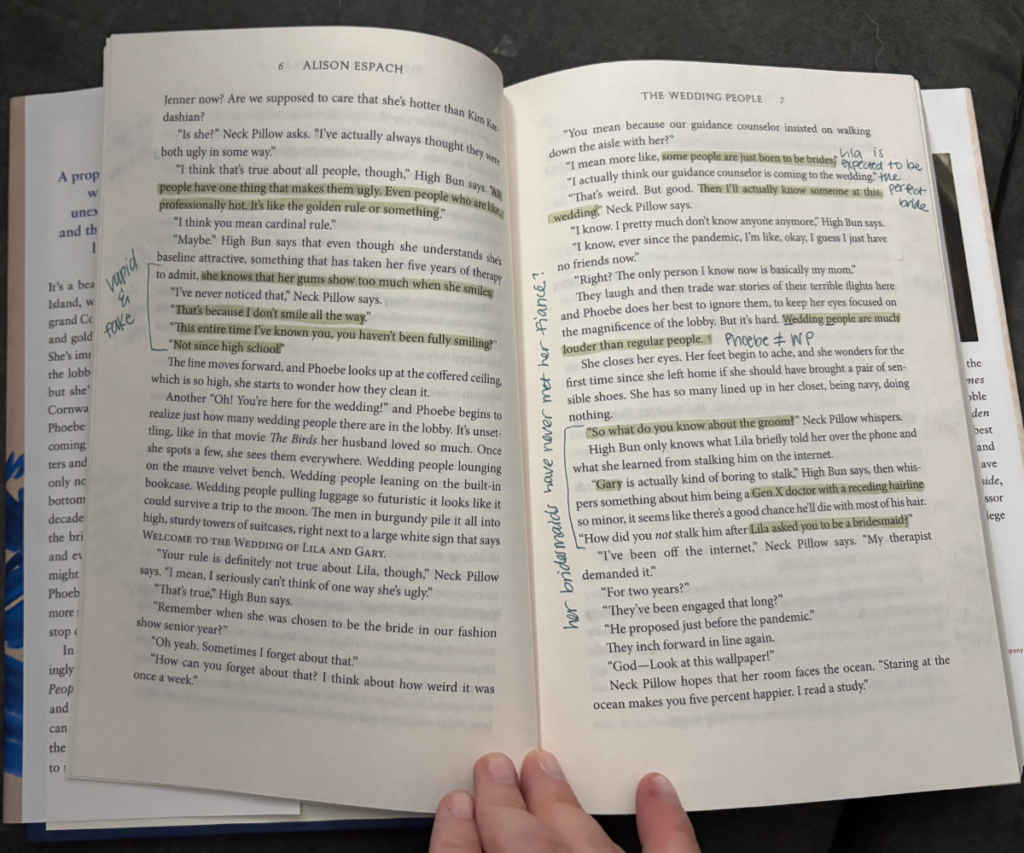
Moving information you read into your memory by using book annotations allows you to…
Using Book Annotations for Deeper Reading Projects
If you’ve ever wanted to go beyond just finishing a book and forgetting it, annotating is essential. In order to really study a book, using book annotations (instead of treating your highlights and margin notes as one-and-done) can help you turn your thoughts into powerful tools for bigger projects.
When you get the hang of tracking themes, noting motifs, and contemplating the implications and reasoning behind them, you can start to feel like your book collection is a personal library that you have curated. Because it is!
Here are the most impactful ways I’ve found to use book annotation ideas:
Themes and Motifs 101
theme – the big idea
- The message or lesson of the story
- Universal concepts like love, redemption, pride, courage
motif – a repeated element
- Repeated images, objects, colors, or phrases
- Reinforces the bigger theme
how to spot themes and motifs
- Look for repetition (what keeps popping up?)
- Track character struggles and lessons learned
- Notice how the story ends—what’s the final takeaway?
Using Book Annotations as a Book Club or Discussion Superpower
The bonus of all this annotating? Your tedious (or not) prep pays off in real-life reading moments.
Whether you’re hosting a book club, writing a meaningful book review, crafting an end-of-year reading wrap-up, or just wanting to remember what you’ve read, using book annotations ensures your best insights aren’t lost to time (or to the bottom of your growing pile of books you’ve read).
When I first joined a book club, I would marvel at the way women would make these profound points.
I didn’t realize that they used annotations the way that they did: to mark conversation-worthy moments as you read, so you can bring them up later at book club.
I started to do this, but I sometimes found that when I’d go back to a book club moment (noted with pink post-it flags, obviously), I sometimes couldn’t make intelligent thoughts happen from what I saw on the page.
This is where clear sticky notes (or just normal, non-see-through sticky notes) come in handy! I jot down a quick recap of why I put my flag on that part (or sometimes I write out my whole thought process… it just depends on my mood and the amount of time I’m willing to leave the plot).
I now note when I connect something with an earlier bit of foreshadowing, or if I think someone else in my group would enjoy or have related to a part, or even if I emotionally connect with a part. There’s no wrong way to annotate. Be creative! This is all about what will serve you later, after reading.
Ok so what do I need?
Everyone is different, when it comes to annotations.
This is typically all that I bring to read…
- a highlighter
- a pen
- a post it note pad (although I’ve been known to scratch notes on junk mail envelopes, old receipts, and pizza boxes when desperate)
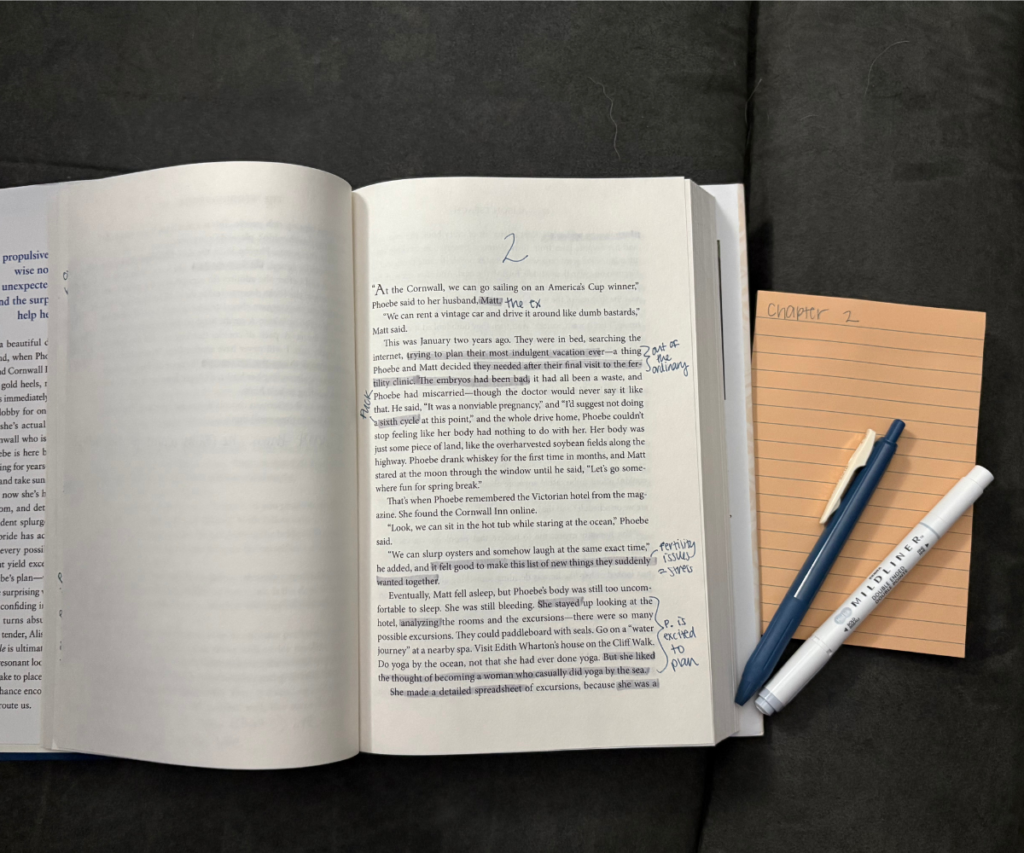
Yeah… I’m going to need a part 4!
Revisiting what you read can be helpful for a variety of reasons, but my favorite is so that the books I fall in love with don’t really leave me.
I love going back through tabbed novels and seeing my thoughts at the time.
I treat annotations like a conversation with the text. And the books I love most almost feel like a back-and-forth between me and the characters or a beloved author.
In part 4, I will touch on how to get out of a reading slump using annotations, how to avoid common annotation pitfalls, and how to make annotating part of your every day life.
Until then, happy reading!